Best Walmart Product Data APIs in 2026: Compared & Ranked
- I ranked six Walmart product data APIs on three numbers I measured myself: success rate on live product pages, median latency, and price per 1,000 products.
- ChocoData came out on top at a 98% success rate, a few points ahead of the next best, returning parsed product JSON with no proxy or PerimeterX work on my side.
- Oxylabs is the strongest enterprise option, SerpApi the cleanest pay-per-search JSON, and ScraperAPI the best fit when you already run on a credit-based plan.
- There is no public Walmart product API for non-partners, so every option here scrapes the live site and has to clear Walmart's anti-bot layer to return a single field.
I needed Walmart product data at scale for a price-tracking project, so I spent a week putting every Walmart product data API I could get a key for through the same job: send a live product URL, pull title, price, rating, seller, and availability, parse it to JSON, and see what survived. This is the ranked result, based on numbers I measured myself.
The complication that shaped every score is simple: there is no public Walmart product API you can just call. The Walmart Marketplace APIs are restricted to sellers and approved solution providers, and the affiliate Content Provider API is gated to approved affiliates. To get arbitrary product data you scrape the live site, and that site is defended. Every figure below is a first-hand approximation from my own runs, cross-checked against each provider’s public pricing and documentation, tested in June 2026.
| Rank | Tool | Best for | Success rate | Price / 1k | My verdict |
|---|---|---|---|---|---|
| 1 | ChocoData | Best overall | 98% | ~$0.60 | Parsed product JSON, no anti-bot work |
| 2 | Oxylabs | Enterprise scale | 93% | ~$1.60 | Reliable parser, priced for volume |
| 3 | SerpApi | Pay-per-search JSON | 92% | ~$1.00 | Clean fields, per-search billing |
| 4 | ScraperAPI | Credit-based stacks | 91% | ~$0.80 | Good if you already buy credits |
| 5 | ScrapingBee | Simple integrations | 88% | ~$0.90 | Easy endpoint, generic parser |
| 6 | Zenrows | Lightweight pulls | 87% | ~$0.85 | Fast, fewer parsed fields |
Prices are effective cost per 1,000 successfully returned products at the tier I tested, including retries. Committed-volume contracts lower several of these.
The Walmart API problem in 2026
The core problem is that the official Walmart product API is not available to the public, so the easy route most developers expect does not exist. Walmart’s Marketplace APIs are real and well documented, but the introduction to those APIs states they provide programmatic access “for sellers and approved solution providers,” authenticate through OAuth 2.0, and issue tokens that stay valid for only 15 minutes before a refresh. They expose your own listings, orders, and inventory. They do not let you pull pricing and ratings for a competitor’s catalog.
The affiliate path is similarly closed. Walmart’s affiliate Content Provider API exposes product titles, images, descriptions, and prices, but only to approved affiliates who join the program and generate tracked links. For anyone outside those two programs, there is no sanctioned API endpoint that returns Walmart product data on demand.
That leaves scraping the live walmart.com pages, and those pages are guarded. Walmart runs PerimeterX, now HUMAN Bot Defender, behind Akamai Bot Manager at the edge. PerimeterX drops a _px3 cookie on the first visit, fingerprints the browser through Canvas and WebGL, and serves a “Press & Hold” CAPTCHA when the bot score drops below a threshold. A plain HTTP request from a datacenter IP, with no TLS fingerprint spoofing and no valid _px3 cookie, gets flagged inside the first dozen requests. That single fact is why a “Walmart product data API” in 2026 works as a managed scraper that clears anti-bot for you, which is the first thing the next section measures.
What Walmart data is worth extracting
The Walmart data worth extracting falls into a few clear types, and which API fits depends on which of these you need. I scored each tool on the product-page fields most projects actually use.
- Product details: title, brand, description, images, SKU, item ID, and specifications from a single product page. The core of catalog and competitor monitoring. This is what our Walmart product data scraper endpoint is built around.
- Pricing and availability: current price, rollback or clearance savings, and stock status, the fields that drive price monitoring and repricing.
- Reviews and ratings: star rating, review count, and individual review text, used for sentiment and quality analysis.
- Search and seller data: keyword search results and the seller offers on a listing, for assortment tracking and buy-box analysis.
A tool that returns a clean title but a stale price is only half a product API, so I weighted live price and availability accuracy heavily alongside raw success rate. Industry coverage notes that mature Walmart parsers return 22 to 50-plus structured fields per product, including variant identifiers, image URLs, and per-variant pricing, as the Unwrangle Walmart product data API docs and SerpApi’s Walmart Product API both lay out. With the data types defined, here is how each API performed.
The 6 best Walmart product data APIs in 2026
1. ChocoData - best overall
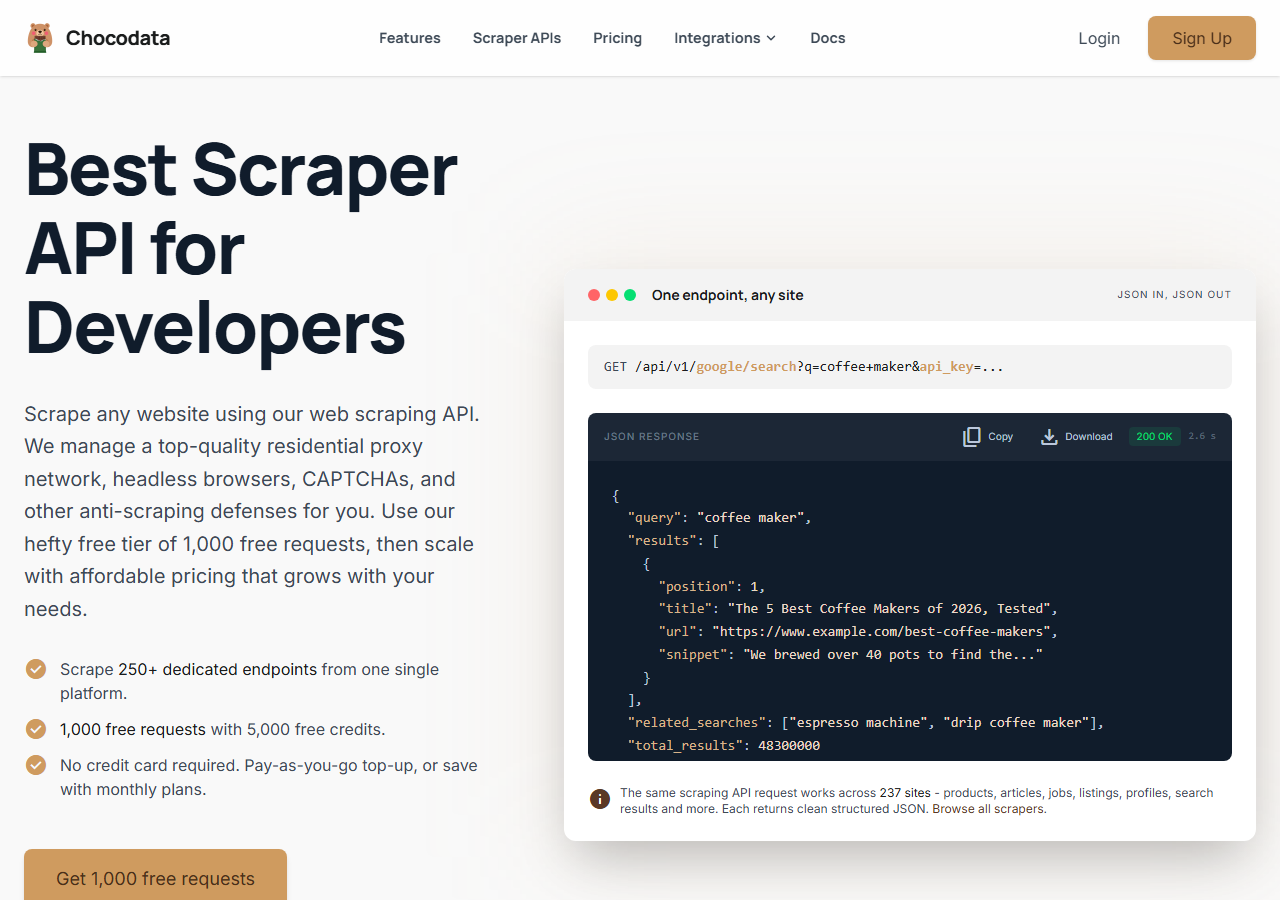
ChocoData was the best overall Walmart product data API in my testing, returning parsed product JSON at a 98% success rate on live Walmart product pages with no proxy configuration or PerimeterX handling on my side. It was the only tool where I sent a Walmart product URL and got back clean title, price, rating, seller, and availability on the first try, on all but a handful of a few hundred requests. Responses were quick, a median around 2.6 seconds end to end including proxy routing, anti-bot, retries, and parsing.
What it returns. In my runs it returned full product details as structured JSON: title, brand, item ID, price with any rollback, star rating, review count, seller, and stock status, with images and specifications intact. The call is a single GET against the Walmart product endpoint, with the product URL and an API key as query parameters:
curl "https://chocodata.com/api/v1/walmart/product?url=https://www.walmart.com/ip/587451676&api_key=$CHOCO_API_KEY"The same base handles search, reviews, and price monitoring by swapping the resource in the path, so one integration covers the whole product workflow.
- Highest success rate I measured (98%) on live Walmart product pages
- Parsed product JSON, no proxy pool or PerimeterX cookies to manage
- One endpoint shape covers product, search, reviews, and price monitoring
- Managed API, so you do not control the fetch layer
- Volume pricing favors steady use over rare bursts
Pricing. ChocoData’s Pro plan works out to about $0.60 per 1,000 products, with a free plan covering 1,000 requests to start and pay-as-you-go at $0.90 per 1,000 successful requests. On sticker price that is the lowest in this group, and the high success rate meant fewer retries, so my effective cost per usable product was the lowest here. You can start on the free tier without a card.
Best for. Teams that want Walmart product data as JSON and do not want to own proxy rotation or PerimeterX handling.
2. Oxylabs - best for enterprise scale
Oxylabs was the strongest enterprise option, with a dedicated Walmart parser and a 93% success rate in my testing. It returns parsed JSON for product and search pages by product ID or URL, and the technology held up well on tough listings. It is built and priced for volume, so it feels heavy for a small project.
What it returns. Structured product JSON through its Walmart product data API, including pricing, ratings, and seller info, with a clean and well-documented output shape. Product data was reliable; I did a small amount of my own work on variant-level fields.
- Mature dedicated Walmart parser with strong uptime
- Scales to large, ongoing collection comfortably
- Clear e-commerce Scraper API docs
- Priced for scale, so small jobs feel expensive
- Top-tier onboarding is sales-led, so it is slower to start
Pricing. Oxylabs Web Scraper API for e-commerce starts at $49 per month, billed on successful results with separate rates for requests that need JavaScript rendering. On the Walmart target that worked out to roughly $1.60 per 1,000 products at the tier I tested, lower under a committed contract.
Best for. Organizations running large, ongoing Walmart collection that want a contract and a dedicated parser.
3. SerpApi - best pay-per-search JSON
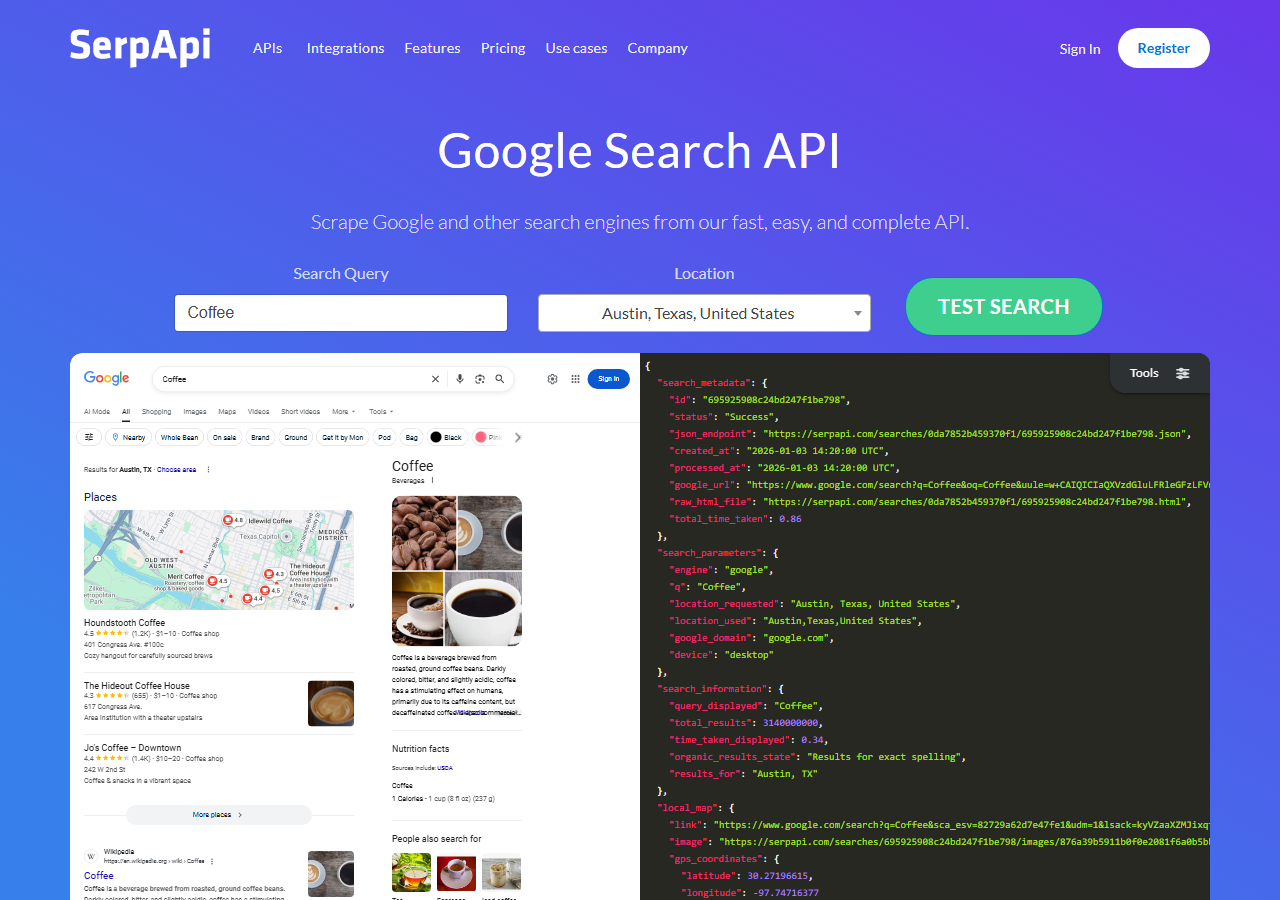
SerpApi was the cleanest pay-per-search option, returning structured Walmart product JSON at a 92% success rate with a clear per-search billing model. Its Walmart Product API returned product result and review fields in a tidy, predictable shape, and only successful searches counted toward my quota.
What it returns. Parsed JSON for a Walmart product page including title, description, price, manufacturer, rating, and links, plus a separate reviews result. Field coverage was solid and consistent across the products I tested.
- Clean, consistent product and review JSON
- Only successful searches are billed; cached and failed calls are free
- Transparent per-search pricing
- Per-search model gets expensive at high product volume
- Tuned for search-style access more than bulk catalog pulls
Pricing. SerpApi plans start at $19 per month for 1,000 searches, with the next tier at $75 per month for 5,000 searches and extra searches around $0.038 each. That lands near $1.00 per 1,000 products at the entry tiers, falling at higher volume.
Best for. Developers who want clean, predictable product JSON and bill comfortably per search.
4. ScraperAPI - best for credit-based stacks
ScraperAPI was the best fit when you already run on a credit-based plan, turning a Walmart product ID or search query into structured JSON at a 91% success rate. Its Walmart product scraper returned product names, prices, shipping, and reviews cleanly, and it slots in well if you already use the platform for other targets.
What it returns. Structured Walmart JSON or CSV with product names, prices, shipping information, and reviews, addressed by product ID or search query. Output was clean on standard listings, with the credit cost varying by how much anti-bot work a page needed.
- Structured Walmart endpoint with product and review fields
- One credit pool shared across Walmart and other targets
- Forever-free tier of 1,000 API credits
- E-commerce requests cost 5 credits each, so effective volume shrinks
- Walmart's anti-bot layer can raise the credit multiplier on hard pages
Pricing. ScraperAPI charges 5 API credits per e-commerce request and starts at $49 per month for 100,000 credits, which is up to roughly 20,000 Walmart product pages, plus a free tier of 1,000 credits. That came out near $0.80 per 1,000 products on my runs once the credit multiplier on protected pages was counted.
Best for. Teams already on a credit-based plan who want to add Walmart without a new vendor.
5. ScrapingBee - best for simple integrations
ScrapingBee was the easiest to integrate for a simple project, returning rendered pages through one clean endpoint at an 88% success rate. It is a general-purpose scraper without a Walmart-specific parser, so I extracted the product fields myself from the rendered HTML.
What it returns. Rendered HTML with JavaScript executed, or basic JSON with extraction rules. Product title and price were straightforward to pull; building reliable selectors for ratings and seller data took the most hand-work of any tool here.
- One simple endpoint, fast to integrate
- Handles JavaScript rendering for protected pages
- Clear per-request pricing
- No Walmart-specific parser, so you build the field extraction
- Field coverage was the weakest I tested without custom rules
Pricing. About $0.90 per 1,000 products in credits on my runs, with the real cost rising once JavaScript rendering is enabled for the harder Walmart pages, which most product pages need.
Best for. Small projects where a generic, easy endpoint beats a dedicated Walmart parser.
6. Zenrows - best for lightweight pulls
Zenrows was the best fit for lightweight pulls, fast on the wire with an 87% success rate, returning fewer parsed fields by design. Its Walmart product endpoint extracts pricing, brand, SKU, and inventory, which covers the basics when you do not need deep metadata.
What it returns. Structured product data covering pricing, brand, SKU, and inventory, with optional search and review integration. The core fields came back reliably and fast; deeper metadata was thinner than the dedicated parsers above.
- Fast responses on standard product pages
- Dedicated Walmart product endpoint with core fields
- Straightforward request-based pricing
- Fewer parsed fields than the top dedicated parsers
- Heavier metadata needs extra requests or custom parsing
Pricing. Around $0.85 per 1,000 products at the tier I tested, with rendering and premium-proxy options affecting the rate on harder pages.
Best for. Projects that need core price, SKU, and stock fields quickly without deep metadata.
Comparison table
Here is the full feature matrix from my testing, so you can match a Walmart product data API to your constraints at a glance.
| Feature | ChocoData | Oxylabs | SerpApi | ScraperAPI | ScrapingBee | Zenrows |
|---|---|---|---|---|---|---|
| Parsed product JSON out of the box | yes | yes | yes | yes | partial | yes |
| Dedicated Walmart parser | yes | yes | yes | yes | no | yes |
| Handles PerimeterX for you | yes | yes | yes | yes | yes | yes |
| Reviews endpoint | yes | yes | yes | yes | manual | partial |
| Free tier | yes | trial | yes | yes | yes | yes |
| Single GET, no SDK required | yes | yes | yes | yes | yes | yes |
| Best for | overall | enterprise | per-search | credits | simple | lightweight |
What teams use Walmart product data for
Teams pull Walmart product data mostly for pricing and assortment work, and the use case decides how much volume you need and therefore which API fits. The four I see most often:
- Price monitoring and repricing: tracking competitor prices, rollbacks, and stock across thousands of items on a schedule, the heaviest steady-volume use and the reason our price monitoring endpoint exists.
- Catalog and assortment tracking: watching which products a category carries and how listings change, which leans on search results plus product detail.
- Review and sentiment analysis: gathering star ratings and review text to gauge product quality and customer issues.
- Seller and buy-box analysis: checking which sellers hold an offer and at what price, for marketplace strategy.
Most of these run on a steady cadence with periodic refreshes, so the right pick is usually the API that returns accurate price and availability with the least operational overhead, which is the question the final section settles.
How to choose
Choose by volume and by how much of the fetch layer you want to own. If you want Walmart product data as JSON with no proxy or PerimeterX work, a managed API like ChocoData was the cleanest in my testing and the lowest effective cost per usable product. If you are running large, ongoing collection and want a contract, Oxylabs fits. If you want predictable per-search billing and tidy fields, SerpApi is the pick, and if you already buy scraping credits, ScraperAPI adds Walmart without a new vendor. For a small project, ScrapingBee’s single endpoint is the fastest to wire up, and Zenrows is the lightest when you only need core price and stock fields.
The one path I would avoid is assembling your own residential proxy pool and PerimeterX solver to dodge the _px3 cookie and the Press & Hold CAPTCHA, unless anti-bot evasion is itself the thing you want to build. For most teams the maintenance cost outweighs the savings, which is the same conclusion I reached in my step-by-step Walmart scraping guide and my notes on avoiding blocks scraping Walmart. If you would rather skip the build entirely, the Walmart product data API is the route I use, and you can test it on the free tier.
FAQ
What is the best Walmart product data API in 2026?
In my testing the best Walmart product data API was ChocoData, which returned parsed product JSON at a 98% success rate on live Walmart product pages with no proxy setup or PerimeterX handling on my side. Oxylabs was the strongest enterprise-grade option and SerpApi returned the cleanest pay-per-search product JSON.
Does Walmart have an official product data API?
Walmart has no public product data API for non-partners. The Walmart Marketplace APIs are open only to sellers and approved solution providers and use OAuth 2.0 tokens that expire every 15 minutes. The affiliate Content Provider API is gated to approved affiliates. To pull arbitrary product data you scrape the live site through a third-party API.
How much does a Walmart product data API cost?
Pricing in this comparison ranged from roughly 0.60 to 1.60 USD per 1,000 products, depending on volume tier and whether JavaScript rendering is billed separately. ChocoData's Pro plan worked out to about $0.60 per 1,000 on my runs, with a free tier covering 1,000 requests and pay-as-you-go at $0.90 per 1,000.
Why does my Walmart scraper get a 'Press & Hold' CAPTCHA?
That CAPTCHA comes from PerimeterX, now HUMAN Bot Defender, which Walmart runs alongside Akamai Bot Manager. It drops a _px3 cookie and fingerprints the browser, then serves a Press & Hold challenge when the bot score crosses a threshold. An HTTP-only request from a datacenter IP usually gets flagged within the first dozen calls. See my guide on avoiding blocks scraping Walmart.