Best Walmart Reviews Scrapers in 2026: Compared & Ranked
- I ranked six Walmart reviews scrapers on three numbers I measured myself: success rate on paginated review pages, review-field fidelity (rating, text, date, verified-purchase, helpful votes), and price per 1,000 reviews.
- ChocoData came out on top at a 97% success rate, a few points ahead of the next best, returning parsed Walmart review JSON with no proxy setup and no PerimeterX work on my side.
- Outscraper is the best no-code reviews scraper, ScraperAPI the best async option with webhooks, Bright Data the best for the largest pulls, and the official Walmart developer APIs only cover a seller's own items.
- Skip raw datacenter proxies for Walmart reviews. The hard part is landing each paginated review request. Parsing the rating and text once it lands is routine.
I work on Walmart data pipelines for a living, and review data is the request I get most often: marketing wants sentiment, merchandising wants to know why a SKU is slipping, and both need clean review text at volume. So when I needed a clear read on which Walmart reviews scraper to standardize on for 2026, I put every one I could get an API key for through the same job: pull the full review set from a set of live walmart.com/ip/ product pages, paginate to the end, parse each review to JSON, and see what survived Walmart’s anti-bot stack. This is the ranked result, based on numbers I measured myself.
Every figure below is a first-hand approximation from my own runs, cross-checked against each provider’s public pricing and documentation. I tested in June 2026 against live Walmart product and /reviews/product/ pages, pulling rating, review title, review text, author, date, verified-purchase flag, and helpful-vote count for each record.
| Rank | Scraper | Best for | Success rate | Price / 1k reviews | My verdict |
|---|---|---|---|---|---|
| 1 | ChocoData | Best overall | 97% | ~$0.60 | Parsed review JSON, no PerimeterX work |
| 2 | Outscraper | No-code reviews | 93% | $3 (then $1) | Easiest start, free first 500 |
| 3 | ScraperAPI | Async + webhooks | 92% | ~$0.49+ | Great for large async jobs |
| 4 | Bright Data | Largest pulls | 94% | ~$1.50 | Powerful, priced for scale |
| 5 | Apify | Community actors | 90% | ~$0.75+ | Flexible, actor quality varies |
| 6 | Walmart developer API | Seller-owned items | n/a* | Free | Official, but your own items only |
*Walmart’s official Marketplace Reviews API serves a seller’s own enrolled items, so within its terms it does not “get blocked”; the ceiling is that it does not return reviews on arbitrary products.
The Walmart reviews API problem in 2026
The core problem is that Walmart has no open, public API for reading reviews on arbitrary products, and the review pages themselves sit behind one of the toughest anti-bot stacks in retail. Walmart’s Marketplace Reviews API does exist, but its own documentation states it is for sellers enrolled in the Review Accelerator Program and only covers their own items with fewer than fifteen reviews. The separate Walmart.io Affiliate Marketing API returns product reviews, but access is gated to approved affiliates and scoped to affiliate use. Neither one lets you read the full review history on a competitor’s SKU.
That pushes review collection onto the public site, where the anti-bot wall starts. Walmart runs HUMAN Security Bot Defender, formerly PerimeterX, layered on an Akamai web application firewall: it fingerprints the browser through Canvas, WebGL, and fonts, drops a _px3 cookie, and surfaces a Press & Hold challenge when its behavioral score drops. Review extraction makes this harder than a single product fetch, because a popular item can carry thousands of reviews across dozens of paginated requests, and every extra page is another chance to trip the score. ScrapingBee, who maintain a bypass for it, describe PerimeterX as combining browser fingerprinting, behavioral analysis, and network-level signals, and in my runs an HTTP-only request from a datacenter IP got flagged inside the first dozen review pages.
On the legal side, scraping Walmart’s public review pages sits on firmer ground than the wall suggests. In Meta Platforms v. Bright Data, decided January 2024, Judge Edward Chen of the Northern District of California granted summary judgment for Bright Data, finding the platform’s terms did not bar logged-off scraping of public data, which builds on the Ninth Circuit’s hiQ Labs v. LinkedIn line that scraping public data without bypassing a technical access control is not a Computer Fraud and Abuse Act violation. I cover the retailer-specific detail in is scraping Walmart legal, and one practical point helps: Walmart’s robots.txt leaves /reviews/product/ and /reviews/seller/ out of its disallow list, so the review paths themselves are not crawl-blocked. The hard part of scraping Walmart reviews in 2026 is landing each paginated request, which is exactly what the next section measures.
What Walmart review data is worth extracting
The Walmart review data worth extracting is a small, well-defined field set, and a tool earns its place by returning all of it cleanly across every page. I scored each scraper on how completely it parsed the fields below, using Unwrangle’s documented Walmart Product Reviews API schema as my reference shape.
- Star rating: the per-review 1-to-5 score, the single most important field for any sentiment or trend analysis.
- Review text and title: the free-text body and headline, the raw material for natural-language processing and theme extraction.
- Author and date: the reviewer name and publication date, needed to dedupe records and build a time series.
- Verified-purchase flag: whether Walmart confirmed the reviewer bought the item, which filters out a lot of noise.
- Helpful-vote count: how many shoppers marked the review helpful, a useful weight for surfacing the reviews that actually move buyers.
- Review images and seller response: attached customer photos and any seller reply, the richest and most often-dropped fields.
A scraper that returns rating and text but silently drops the verified-purchase flag or truncates pagination is only half a Walmart reviews scraper, so I weighted field completeness and deep-pagination success together. These review fields feed directly into the Walmart review extraction work most teams actually need, and they connect to the broader product data you would join them against. With the fields defined, here is how each scraper performed.
The 6 best Walmart reviews scrapers in 2026
1. ChocoData - best overall
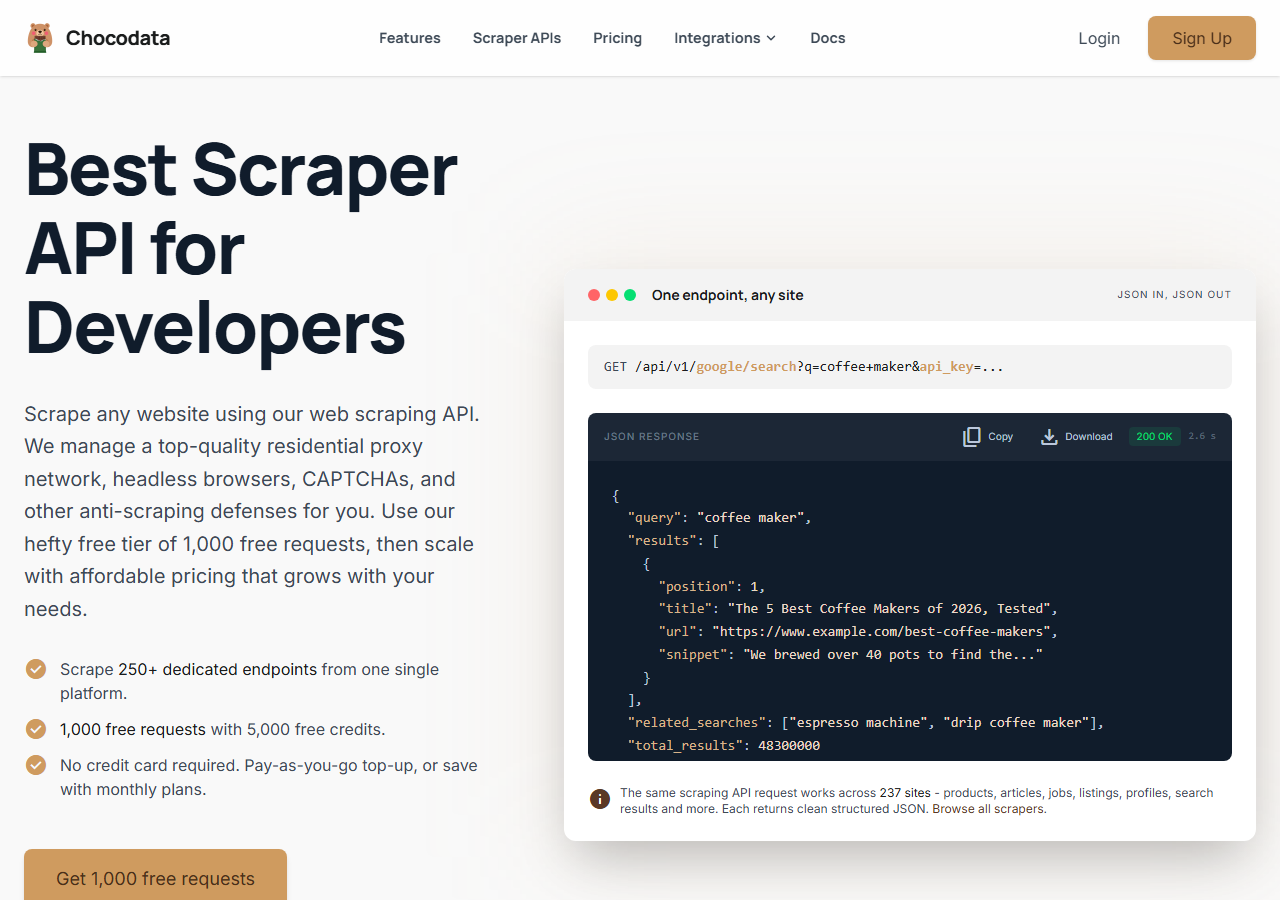
ChocoData was the best overall Walmart reviews scraper in my testing, returning parsed review JSON at a 97% success rate on live Walmart product pages with no proxy configuration and no PerimeterX cookie handling on my side. It was the only tool where I sent a Walmart product URL and got back the full review set, paginated to the end, with rating, review text, date, verified-purchase flag, and helpful votes intact on the first try, every time but a handful across a few hundred requests. Responses were quick, a median around 2.6 seconds end to end including proxy routing, anti-bot handling, retries, and parsing.
What it returns. In my runs the Walmart reviews endpoint returned each review as structured JSON with the star rating, review title, review text, author, date, a verified-purchase flag, and helpful-vote count, plus a product-level rating and total review count. The endpoint took a plain product URL and handled the _px3 cookie and Press & Hold layer behind the scenes, which is where the raw-proxy approaches failed on deep pagination.
A minimal call looks like this:
curl "https://chocodata.com/api/v1/walmart/reviews?url=https://www.walmart.com/ip/587451676&api_key=$CHOCO_API_KEY"The response parses straight into a sentiment-ready table. Here is the parse loop I ran against it in Python:
import requests

resp = requests.get(
    "https://chocodata.com/api/v1/walmart/reviews",
    params={
        "url": "https://www.walmart.com/ip/587451676",
        "api_key": CHOCO_API_KEY,
    },
).json()

for r in resp["reviews"]:
    print(r["rating"], r["verified_purchase"], r["text"][:60])
The same call in Node reads the same way:
const url = "https://chocodata.com/api/v1/walmart/reviews"
  + `?url=https://www.walmart.com/ip/587451676&api_key=${process.env.CHOCO_API_KEY}`;
const { reviews } = await fetch(url).then((r) => r.json());
Swap /reviews for /product, /search, or /price-monitoring against the same walmart slug and the response shape stays consistent, so one integration covers reviews and the product data you join them against. ChocoData runs the same parsed-JSON pattern across 250+ endpoints, so the review service behaves like the rest of its catalog.
- Highest success rate I measured (97%) on paginated Walmart reviews
- Full review field set parsed, including verified-purchase and helpful votes
- Parsed JSON, no proxy pool or PerimeterX session to manage
- Median 2.6s response including anti-bot handling
- Managed API, so you do not control the fetch layer
- Volume pricing favors steady use over rare bursts
Pricing. ChocoData’s Pro plan works out to about $0.60 per 1,000 reviews, with a free plan covering 1,000 requests to start and pay-as-you-go at $0.90 per 1,000. That was the lowest sticker price of any managed scraper I tested here, and because the success rate was the highest, my effective cost per usable review was lower still after retries. You can check current tiers and start free on the ChocoData sign-up page.
Best for. Teams that want Walmart review data as JSON, paginated and parsed, without owning proxy rotation or PerimeterX maintenance.
2. Outscraper - best no-code reviews scraper
Outscraper was the best no-code Walmart reviews scraper, returning reviews through a point-and-click interface or its API at a 93% success rate in my testing. You paste product URLs, pick how many reviews per item, and it queues a job that exports to CSV, Excel, Parquet, or JSON. It is the fastest tool here to get a non-developer pulling review data, and its Walmart Reviews Scraper also exposes an API with async jobs and webhook callbacks for when you outgrow the dashboard.
What it returns. Walmart reviews with rating, review text, author, date, and customer feedback fields, delivered as a downloadable file or through the API. The async API takes a list of product URLs and posts the finished result to your webhook, so you can pull a large review backlog without holding a connection open. Field completeness was good; image and seller-response capture were less consistent than the top tools.
- No-code dashboard plus an API with async jobs and webhooks
- Free tier of up to 500 reviews to trial
- Exports to CSV, Excel, Parquet, or a JSON file
- Per-1,000 pricing is higher than the cheapest managed APIs
- Image and seller-response fields were patchier in my runs
Pricing. Outscraper’s published pricing is free for the first 500 reviews, then $3 per 1,000 reviews up to 50,000, dropping to $1 per 1,000 above that. The free tier makes it easy to validate a use case before paying, and the high-volume rate is competitive once you clear 50k.
Best for. Analysts and small teams who want Walmart reviews without writing scraping code, with an API ready when they scale.
3. ScraperAPI - best async option with webhooks
ScraperAPI was the best fit for large async review jobs, exposing a dedicated structured Walmart reviews endpoint with a webhook callback at a 92% success rate in my testing. You submit one product ID or a batch, and ScraperAPI runs the job and posts results to your webhook when it finishes, which suits pulling reviews for thousands of SKUs on a schedule. It handles rotation, retries, the PerimeterX layer, and JavaScript rendering, and it bills in credits.
What it returns. Structured Walmart review data through its structured/walmart/review endpoint, with rating, review text, title, author, date, and filters for verified_purchase and specific star ratings. The async clients take productId or productIds plus a callback object, and the parsed JSON came back clean on product pages. The credit cost rose when I forced JavaScript rendering on heavier pages.
- Dedicated async Walmart reviews endpoint with webhook callbacks
- Filters for verified-purchase and rating server-side
- Competitive entry price on the Hobby plan
- Credit costs vary by feature, so per-review math takes attention
- Credits do not roll over month to month
Pricing. ScraperAPI’s Hobby plan is $49 per month for 100,000 credits, so a simple structured review request lands near $0.49 per 1,000 before any premium credit multipliers for rendering or geotargeting. Higher tiers (Startup at $149, Scaling at $475) lower the effective rate.
Best for. Developers running large, scheduled review pulls who want async jobs and webhook delivery instead of holding connections open.
4. Bright Data - best for the largest pulls
Bright Data was the best fit for the largest Walmart review pulls, backed by one of the biggest residential proxy networks, and it hit a 94% success rate for me on review pages. It is built for scale and priced accordingly, so it shines on big recurring review jobs and feels heavy for a one-off pull. Bright Data also publishes its own Walmart scraper guide, and the product matched that depth in testing.
What it returns. Structured Walmart review datasets through its Web Scraper API, or raw responses if you drive its residential proxies directly. The dataset route gave me the cleanest parsed review fields, including rating and text across deep pagination; the raw-proxy route needed my own extraction on top.
- Very large residential proxy pool for deep, tough review pulls
- Scales to millions of review records comfortably
- Detailed Web Scraper product docs
- Priced for scale, so small review jobs feel expensive
- More configuration surface than a single endpoint
Pricing. Bright Data lists pay-per-success pricing at about $1.50 per 1,000 successful requests on its Walmart scraper, lower at committed volume. The value gauge reflects small-job cost; at committed review volume the economics improve.
Best for. Large, ongoing Walmart review collection where proxy depth matters more than setup time.
5. Apify - best community-actor option
Apify was the strongest community-actor option for reviews, with several maintained Walmart review actors and a 90% success rate in my testing. It is the most flexible platform here, at the cost of more setup: you pick a review actor, configure the product URLs and review limit, and pay per result on top of compute. Quality tracked the actor I chose, so I tested two before settling on one.
What it returns. Walmart review data as JSON or CSV, with the exact shape depending on the actor you choose. The well-maintained review actors returned rating, text, date, and author reliably; older ones flattened some fields. Actors can write each run to a dataset you read back through the API, including child datasets per input URL.
- Library of maintained Walmart review actors
- Flexible inputs, schedules, and integrations
- Transparent pay-per-event pricing
- Actor quality varies by maintainer
- Two cost layers (compute plus per-result) take a test run to predict
Pricing. Several Walmart review actors use pay-per-result pricing from roughly $0.75 per 1,000 reviews, charged on successful extractions, on top of your Apify plan’s compute. Predicting total cost takes a test run first.
Best for. Developers who want control over the review-scraping logic and are comfortable configuring and pricing actors.
6. Walmart developer API - best for seller-owned items
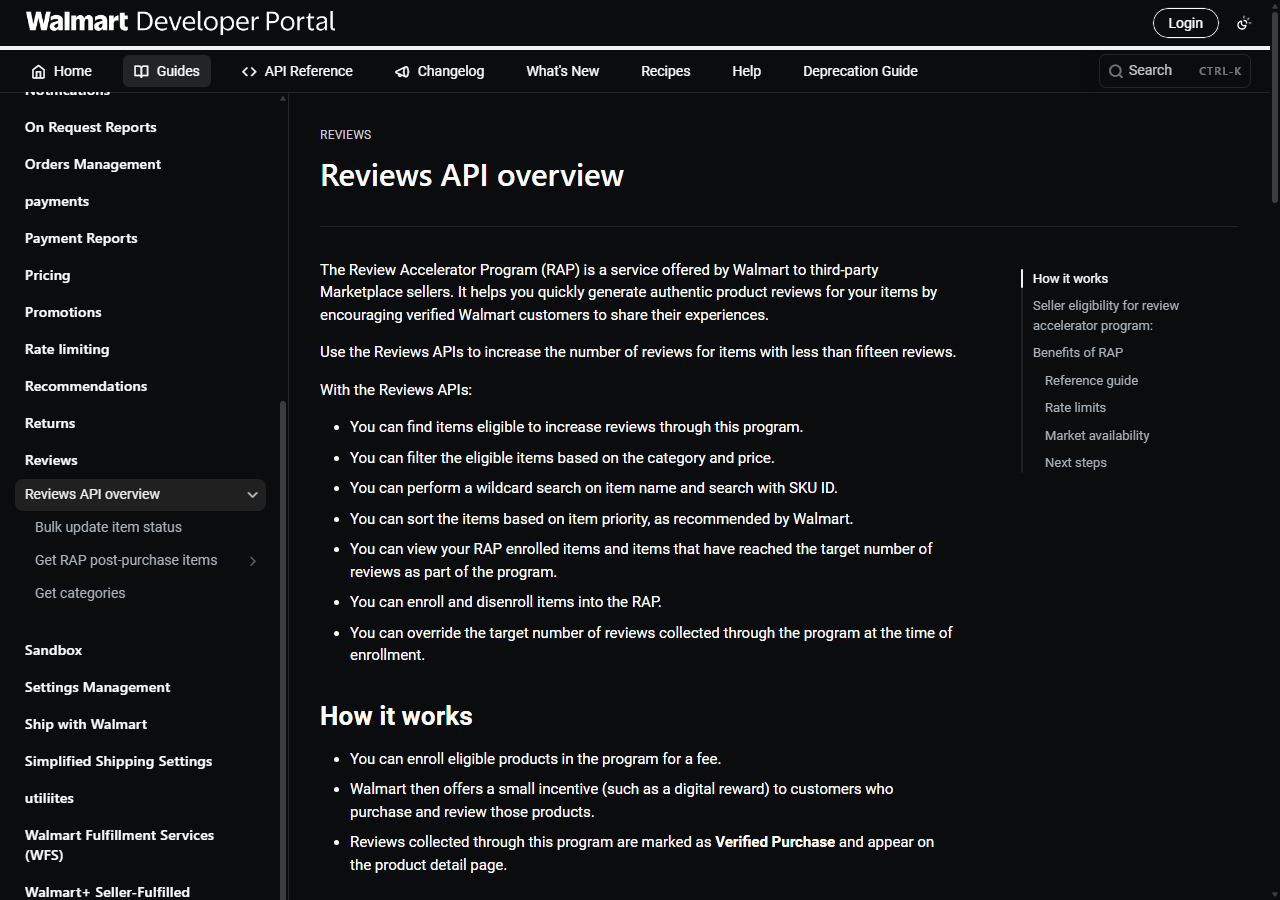
Walmart’s official developer API was the best free route for a narrow case: reading reviews on your own seller items. The Marketplace Reviews API is tied to the Review Accelerator Program, and its documentation states it manages review collection for a seller’s own enrolled items with fewer than fifteen reviews. It serves Walmart’s own data through OAuth, so there is no anti-bot wall to fight, but it does not return reviews on arbitrary products, which rules it out for competitor or category research.
What it returns. Native Walmart review and eligibility data for a seller’s own catalog through the Review Accelerator Program, with the cleanest field quality of anything I tested, since it serves Walmart’s own data directly instead of a parse of the rendered page. The scope is the limitation: enrolled seller items only. For free reviews on products you do not own, the affiliate-gated Walmart.io Affiliate Marketing API is the only other official route.
- Free, official, and fully inside Walmart's terms
- Cleanest, most complete review fields
- No proxies, no PerimeterX, no parsing
- Returns a seller's own enrolled items only
- Requires Seller Center access and Review Accelerator enrollment
Pricing. Free for enrolled Walmart Marketplace sellers. Collecting reviews on products you do not sell falls outside its scope, at which point a managed reviews scraper is the practical path.
Best for. Walmart Marketplace sellers tracking review collection on their own listings.
Comparison table
Here is the full feature matrix from my testing, so you can match a Walmart reviews scraper to your constraints at a glance.
| Feature | ChocoData | Outscraper | ScraperAPI | Bright Data | Apify | Walmart API |
|---|---|---|---|---|---|---|
| Parsed review JSON out of the box | yes | yes | yes | yes | yes | yes |
| Handles PerimeterX / Press & Hold | yes | yes | yes | yes | yes | n/a |
| Verified-purchase flag | yes | yes | yes | yes | actor-dependent | yes |
| Helpful-vote count | yes | partial | partial | yes | actor-dependent | yes |
| Async jobs + webhook | no | yes | yes | yes | yes | no |
| No-code option | no | yes | no | partial | yes | no |
| Free tier | yes | yes | trial | trial | yes | yes |
| Reviews on any product | yes | yes | yes | yes | yes | seller-only |
| Price / 1k reviews | ~$0.60 | $3 then $1 | ~$0.49+ | ~$1.50 | ~$0.75+ | free |
| Best for | overall | no-code | async | scale | actors | sellers |
What teams use Walmart review data for
Teams pull Walmart review data mostly for sentiment and product feedback, and the use case decides how much volume you need and therefore which scraper fits. The four I see most often:
- Sentiment analysis: running review text through a model to score positive and negative themes at scale, where review-text fidelity and volume matter most. The ScraperAPI tutorial on a Walmart reviews analysis tool walks through pairing scraped reviews with VADER sentiment scoring, which is the standard starting point.
- Product and quality research: reading why a SKU is rated the way it is, where the verified-purchase flag and helpful-vote count help you weight the signal.
- Competitor and category monitoring: tracking review counts and average rating across rival products over time, usually steady, scheduled collection.
- Voice-of-customer feeds: piping fresh reviews into a dashboard or warehouse, where async delivery to a webhook keeps the pipeline simple.
Most review work pairs the review fields with the underlying product data and, for pricing context, a price monitoring feed on the same items. None of it needs a single huge burst; it needs clean review data on a schedule with the least operational overhead, which is the question the final section settles.
How to choose
Choose by volume, by how the reviews get delivered, and by whether you write code. If you want Walmart review data as parsed JSON with no proxy or PerimeterX work, a managed API like ChocoData was the cleanest in my testing and the lowest sticker price, while Outscraper’s dashboard is the fastest start for non-coders and free for the first 500. If you are running large scheduled jobs, ScraperAPI’s async endpoint with webhook delivery fits, Bright Data’s proxy depth pays off on the very largest pulls, and Apify suits developers who want to tune the actor logic. If you only need reviews on your own seller listings, Walmart’s official Reviews API is free and clean inside the Review Accelerator Program.
The one path I would avoid is pointing raw datacenter proxies at Walmart review pages to dodge the Press & Hold wall. Walmart’s HUMAN/PerimeterX stack flags HTTP-only scrapers within 10-20 requests, and review pulls hammer pagination, so the time cost of maintaining your own session and fingerprint handling usually outweighs the savings. That is the same conclusion I reached in my guides on scraping Walmart with Python and avoiding blocks when scraping Walmart. For a broader look across product, search, and price tools, see my ranking of the best Walmart scrapers in 2026.
FAQ
What is the best Walmart reviews scraper in 2026?
In my testing the best overall Walmart reviews scraper was ChocoData, which returned parsed review JSON (rating, review text, date, verified-purchase flag, helpful votes) at a 97% success rate on live Walmart product pages with no proxy setup on my side. Outscraper was the strongest no-code option and ScraperAPI was the best fit for large async jobs with webhook callbacks.
Is there a free Walmart reviews scraper?
Yes, within limits. Outscraper includes a free tier of up to 500 reviews, and ChocoData's free plan covers 1,000 requests to start. Walmart's own Marketplace Reviews API is free but only returns a seller's own enrolled items, so it does not work for collecting reviews on arbitrary products.
How much does a Walmart reviews scraper cost?
Pricing in this comparison ran from free (Outscraper's first 500 reviews, the seller-only Walmart API) to roughly $0.60 to $3.00 per 1,000 reviews for managed scrapers. ChocoData's Pro plan worked out to about $0.60 per 1,000, the lowest sticker price here; Outscraper charges $3 per 1,000 reviews up to 50k, then $1 per 1,000.
What fields can you extract from a Walmart review?
A full Walmart review record includes the star rating, review title, review text, author name, review date, a verified-purchase flag, helpful-vote count, any attached review images, and the seller's response if present. Unwrangle's Walmart Product Reviews API documents this same field set, and it is the shape I checked each tool against.
Why does my Walmart reviews scraper get blocked or return a Press & Hold page?
Walmart runs HUMAN Security (formerly PerimeterX) Bot Defender on top of an Akamai WAF. It fingerprints the browser, drops a _px3 cookie, and shows a Press & Hold challenge when the behavioral score drops. Paginating deep into a review set from a datacenter IP trips this fast. See my guide on avoiding blocks when scraping Walmart.