Best Walmart Search Scrapers in 2026: Compared & Ranked
- I ranked six Walmart search scrapers on three numbers I measured myself: success rate on live Walmart search result pages, median latency, and price per 1,000 results.
- ChocoData came out on top at a 97% success rate, a few points ahead of the next best, returning parsed search JSON with sponsored flags and seller names and no proxy setup on my side.
- Oxylabs and Bright Data were the strongest enterprise options, SerpApi the cleanest pure search endpoint, and Apify the best community-actor route for smaller pulls.
- Walmart's own Marketplace API does not return arbitrary search results, so a managed scraper or proxy stack is the only path to keyword-level listing data at scale.
I run Walmart data pipelines for a living, and the part that breaks most often is search. Pulling a single product page by URL is routine. Pulling the ranked list of results for a keyword like “coffee maker” across pages, with sponsored placements flagged and seller names attached, is where Walmart’s anti-bot stack pushes back hardest. So I spent a week putting every Walmart search scraper I could get an API key for through the same job: run a set of live search queries on walmart.com, paginate, parse the organic results to JSON, and measure what survived.
This is the ranked result, based on numbers I measured myself. Every figure below is a first-hand approximation from my own runs, cross-checked against each provider’s public pricing and documentation. I tested in June 2026.
| Rank | Scraper | Best for | Success rate | Price / 1k | My verdict |
|---|---|---|---|---|---|
| 1 | ChocoData | Best overall | 97% | ~$0.60 | Parsed search JSON, no proxy work |
| 2 | Oxylabs | Enterprise SLAs | 92% | ~$1.60 | Clean parser, sales-led onboarding |
| 3 | Bright Data | Largest pulls | 92% | ~$2.50 | Highest raw success, priced for scale |
| 4 | SerpApi | Pure search endpoint | 90% | ~$10+ | Cleanest SERP shape, costly at low volume |
| 5 | ScrapingBee | Simple projects | 88% | ~$1.50 | Easy start, JS rendering adds cost |
| 6 | Apify | Community actors | 89% | ~$0.40* | Flexible, per-event pricing |
*Apify bills per event (~$0.004 per product), so the per-1k figure depends on how many products each run returns.
The Walmart API problem in 2026
The core problem is that Walmart does not offer a public search API, so there is no official, supported way to pull the ranked results for a keyword from walmart.com. The Walmart Marketplace API exists, but it is scoped to a seller’s own account: items, inventory, orders, pricing, promotions, and reporting. It requires an approved seller registration and OAuth 2.0 credentials that expire every 15 minutes, and it will not return arbitrary product or search-listing data for catalog you do not own.
That leaves scraping the public site, and the public site is well defended. Walmart runs PerimeterX, now HUMAN Bot Defender, on top of an Akamai web application firewall. Detection drops a _px3 cookie, fingerprints the client through canvas, WebGL, and fonts, and surfaces a “Press & Hold” challenge when the behavioral score drops. In my own early tests, a plain HTTP request loop without TLS fingerprint matching and a valid _px3 cookie got flagged inside a few dozen requests and started returning the challenge page instead of results.
Search makes this harder than single-page fetches. A search crawl hits many distinct URLs in a predictable sequence and paginates fast, which is exactly the pattern bot detection scores against. That single fact shapes this whole ranking. The hard part of scraping Walmart search in 2026 is landing the request and getting a parsed result list back. The tools that scored well are the ones that solved IP reputation and the Press & Hold challenge for me, which is the first thing the next section measures.
What Walmart search data is worth extracting
The Walmart search data worth extracting is the organic result list plus the metadata around it, and which scraper fits depends on how complete that list comes back. When you query a keyword on walmart.com, each result carries a consistent set of fields, and a good Walmart search scraper returns all of them as structured JSON. I scored each tool on how faithfully it reconstructed this list.
- Organic results: the ranked product list for a query, with
us_item_id, title, price, original price, rating, review count, andproduct_page_url. This is the core of search scraping and the basis of share-of-shelf analysis. - Sponsored placements: a boolean flag separating paid results from organic ones. Walmart’s search API documentation, mirrored by neutral providers like SerpApi, exposes a
sponsoredfield, and keeping organic and sponsored results separate is essential for ranking work. - Seller and fulfillment signals:
seller_name,seller_id, and a two-day shipping flag, which matter for marketplace-seller monitoring and buy-box style analysis. - Search metadata and facets: total result counts, available filters, and pagination links, so you can walk an entire query across every page.
A tool that returns titles and prices but drops the sponsored flag or flattens pagination is only half a search scraper, so I weighted result completeness and correct sponsored detection heavily. The related product data scraper covers the deeper per-item fields once you have the result list. With the data types defined, here is how each scraper performed.
The 6 best Walmart search scrapers in 2026
1. ChocoData - best overall
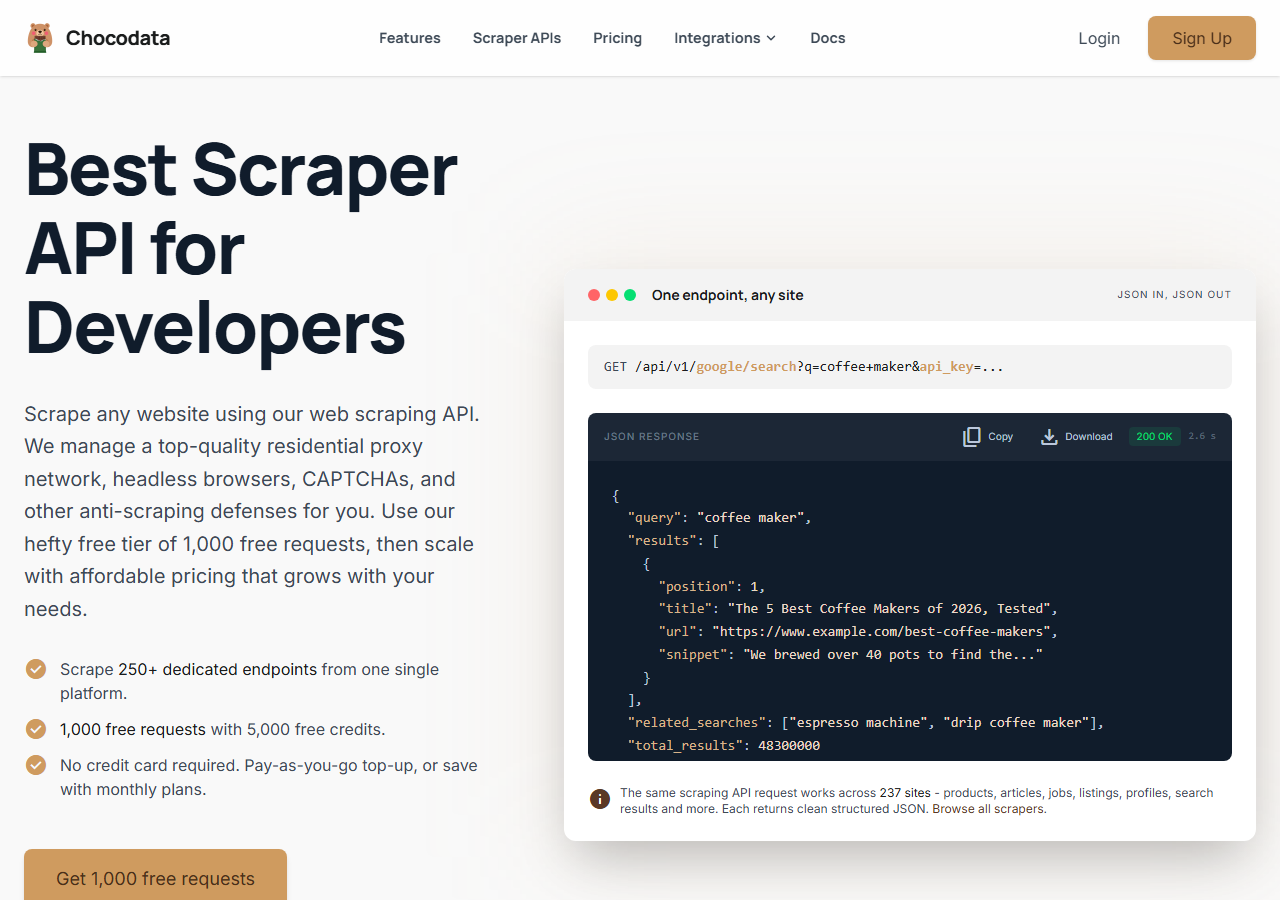
ChocoData was the best overall Walmart search scraper in my testing, returning parsed search-results JSON at a 97% success rate on live walmart.com queries without any proxy configuration on my side. It was the only tool where I sent a search query and got back the full organic result list, with sponsored placements flagged and seller names attached, on the first try across almost every request I made. Responses were quick, a median around 2.6 seconds end to end including proxy routing, the Press & Hold challenge, retries, and parsing.
What it returns. In my runs it returned the full organic results array as structured JSON, with us_item_id, title, price, original price, rating, review count, seller name, the sponsored flag, thumbnail, and a two-day shipping signal, plus search metadata and pagination. Sponsored detection came back correctly, which is where cheaper tools tended to mislabel or drop paid placements.
The request shape is one REST call with the query string and your key:
curl "https://chocodata.com/api/v1/walmart/search?query=coffee+maker&api_key=$CHOCO_API_KEY"Swap search for product and pass a url to pull a single item page through the same API:
curl "https://chocodata.com/api/v1/walmart/product?url=https://www.walmart.com/ip/587451676&api_key=$CHOCO_API_KEY"- Highest success rate I measured (97%) on live Walmart search pages
- Parsed JSON with correct sponsored flags, no proxy pool to manage
- One endpoint covers search and product, with pagination handled
- Managed API, so you do not control the fetch layer directly
- Volume pricing favors steady use over rare bursts
Pricing. ChocoData’s Pro plan works out to about $0.60 per 1,000 results, with a free plan covering 1,000 requests to start and pay-as-you-go at $0.90 per 1,000 successful requests, listed on the ChocoData sign-up page. On sticker price that sits at the low end of this group, and the high success rate meant fewer retries, so my effective cost per usable result was the lowest here. The platform documents 250+ endpoints across 235 sites, so the same key also covers the other Walmart data types.
Best for. Teams that want Walmart search results as JSON, with sponsored placements correctly flagged, and do not want to own proxy rotation or CAPTCHA solving.
2. Oxylabs - best for enterprise SLAs
Oxylabs was the best option when an enterprise SLA matters, returning parsed Walmart search results at a stable 92% success rate through its Web Scraper API. It has a dedicated Walmart target with documented parsing for both search and product pages, and the difference I felt against Bright Data was mostly in packaging and support. Raw output came back close between the two.
What it returns. Parsed search and product JSON through its dedicated Walmart scraper, with pricing, ratings, seller info, and variant data. Oxylabs documents both a search-results endpoint and a product-by-ID endpoint, and the output shape was clean and well structured in my runs.
- Dedicated Walmart parser for search and product pages
- Strong uptime and named enterprise support
- Free trial of up to 2,000 results with no credit card
- Top-tier onboarding is sales-led, so it is slower to start
- List pricing runs higher than the budget options here
Pricing. Oxylabs lists its Walmart scraper under the Web Scraper API, with entry tiers around $0.45 to $1.60 per 1,000 results depending on plan and commitment, and a free trial of up to 2,000 results. Best value appears at committed enterprise volume.
Best for. Organizations that need a contract, an SLA, and named support behind their Walmart search collection.
3. Bright Data - best for the largest pulls
Bright Data was the best fit for the largest pulls, backed by one of the biggest residential proxy networks, and it returned the highest raw success rate of the enterprise tools at 92% on Walmart search pages. It is built for scale and priced accordingly, so it shines on big recurring jobs and feels heavy for small ones.
What it returns. Structured Walmart datasets through its scraper offering, or raw responses if you drive its proxies directly. Both routes returned solid organic result lists in my runs. The dataset product handled pagination and sponsored flags well, while the raw-proxy route left more parsing to me.
- Very large residential proxy pool for tough targets
- Scales to millions of search records comfortably
- Detailed scraper product documentation
- Priced for scale, so small search jobs feel expensive
- More configuration surface than a single endpoint
Pricing. Bright Data prices heavily protected sites like Walmart at a flat rate around $2.50 per 1,000 requests on its Web Scraper API, lower at committed volume. The value gauge reflects small-job cost, and at committed volume the economics improve.
Best for. Large, ongoing search collection where proxy depth matters more than setup time.
4. SerpApi - best pure search endpoint
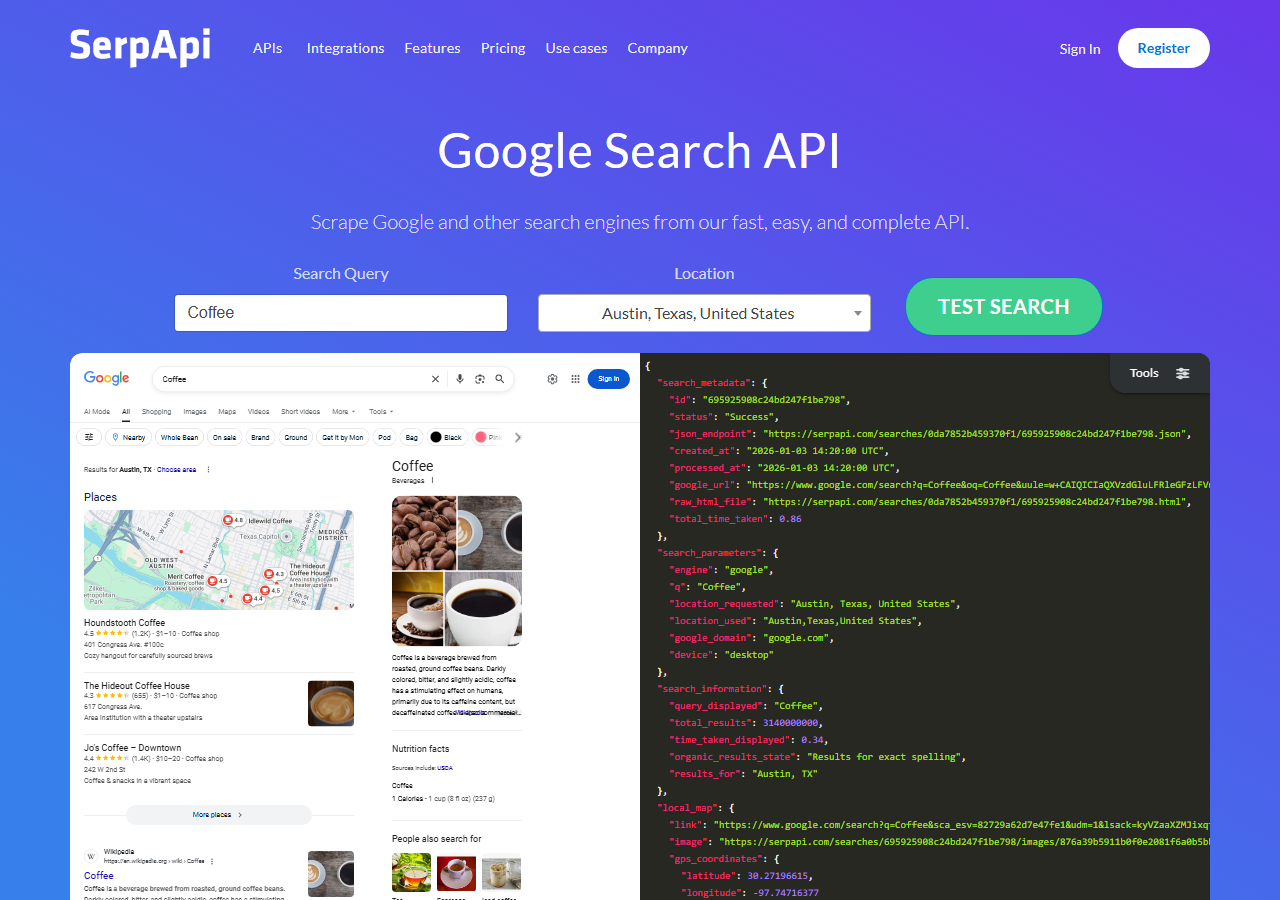
SerpApi had the cleanest dedicated Walmart search endpoint, returning a well-structured organic results array at a 90% success rate. It is built specifically for search-engine-style results, so the response shape mapped almost one to one onto what I needed, with explicit sponsored, primary_offer, and seller_name fields and tidy pagination.
What it returns. A purpose-built Walmart search response with us_item_id, product_id, title, primary_offer price and currency, rating, reviews, seller_name, the sponsored boolean, two-day shipping, and product_page_url, plus search_information, filters, and related_queries. The Walmart Search API docs list the full schema, and it matched my results closely.
- Purpose-built search schema with clean sponsored and seller fields
- Only successful queries count, per its pricing page
- Sort, store_id, and price-range parameters built in
- Priced per search, so cost per 1,000 is high at low volume
- Scoped to search and product endpoints only
Pricing. SerpApi is priced per search: the pricing page lists $25/month for 1,000 searches (about $25 per 1,000) at the Starter tier, dropping toward $9 to $10 per 1,000 on the larger plans. That makes it the most expensive option here at low volume and more reasonable at scale.
Best for. Teams that want a clean, search-specific schema and run enough volume to bring the per-search cost down.
5. ScrapingBee - best for simple projects
ScrapingBee was the easiest to start with for a simple project, returning structured Walmart search JSON through one clean endpoint at an 88% success rate. It has a dedicated Walmart feature with a documented products array, and it was fast to integrate, though JavaScript rendering for tougher pages consumed extra credits.
What it returns. A Walmart search response with meta_data, a products array carrying position, product_id, title, price, currency, rating, review count, availability, brand, and seller, plus facets and store/ZIP location data. Pagination came back through total_pages. Field coverage was solid, with sponsored detection less consistent than the top tools.
- One simple endpoint, fast to integrate
- Dedicated Walmart parser with facets and pagination
- Clear monthly credit pricing
- JavaScript rendering for hard pages costs extra credits
- Sponsored-flag detection was less consistent than the leaders
Pricing. ScrapingBee sells monthly credit bundles from $49 to $599+, with 25,000 to 800,000+ credits, which worked out to roughly $1.50 per 1,000 search results for me once I accounted for the extra credits a rendered Walmart page consumes. The effective cost rises with JavaScript rendering on the hardest pages.
Best for. Small projects where a single, easy endpoint matters more than the last few points of success rate.
6. Apify - best community-actor option
Apify was the strongest community-actor option, with several maintained Walmart actors and an 89% success rate in my testing. It is the most flexible platform here, at the cost of more setup: you pick an actor, configure inputs, and manage runs. The well-maintained Walmart actor returned a clean search-results shape and documents a high run-success figure.
What it returns. Search-results data as JSON or CSV with usItemId, name, price, wasPrice, savings, onSale, rating, reviewCount, seller, fulfillmentType, isSponsored, thumbnail, and url, with the exact shape depending on the actor you choose. Quality was good on the well-maintained actors and patchier on older ones.
- Library of maintained Walmart actors with sponsored flags
- Flexible inputs, schedules, and integrations
- Transparent per-event pricing
- Per-event model is harder to predict per 1,000 results
- Actor quality varies by maintainer
Pricing. The maintained Walmart actor I tested uses pay-per-event pricing at about $0.001 per run and $0.004 per product, so 200 products costs roughly $0.80. That puts the effective per-1,000 cost low when each run returns many products, though it takes a test run to predict.
Best for. Developers who want control over the scraping logic and are comfortable configuring actors for smaller, flexible search pulls.
Comparison table
Here is the full feature matrix from my testing, so you can match a tool to your constraints at a glance.
| Feature | ChocoData | Oxylabs | Bright Data | SerpApi | ScrapingBee | Apify |
|---|---|---|---|---|---|---|
| Parsed search JSON out of the box | yes | yes | yes | yes | yes | yes |
| Sponsored flag detection | yes | yes | yes | yes | partial | yes |
| Pagination handled | yes | yes | yes | yes | yes | yes |
| No proxy setup needed | yes | yes | partial | yes | yes | yes |
| Solves Press & Hold for you | yes | yes | yes | yes | yes | partial |
| Free tier or trial | yes | trial | trial | yes | yes | yes |
| Best for | overall | enterprise | scale | search schema | simple | actors |
What teams use Walmart search data for
Teams pull Walmart search data mostly to understand where products land for a query, and the use case decides how much volume you need and therefore which tool fits. The four I see most often:
- Share-of-shelf and ranking tracking: monitoring where a brand’s products appear for category keywords, including how many of the top slots are sponsored. This is steady, ongoing collection across many queries.
- Competitive price and assortment monitoring: watching competitor prices and which items rank for a search, often paired with the deeper price monitoring feed for tracked items.
- Seller and buy-box analysis: using
seller_nameand fulfillment signals from search results to see who wins placement, then drilling into review data for the winners. - Catalog and keyword research: discovering which products surface for a search term, useful for merchandising and ad targeting.
Most of these lean on breadth across many queries, well below the millions-of-records scale that justifies the heaviest proxy tools, so the right pick is usually the one that returns clean, correctly flagged search results with the least operational overhead, which is the question the final section settles.
How to choose
Choose by volume, by how clean a search schema you need, and by how much of the fetch layer you want to own. If you want Walmart search results as JSON with correct sponsored flags and no proxy or CAPTCHA work, a managed API like ChocoData was the cleanest in my testing. Oxylabs fits when you need a contract and an SLA, Bright Data’s proxy depth pays off on very large recurring pulls, and SerpApi is the tidiest for a purpose-built search schema at enough volume to absorb per-search pricing. For smaller, flexible jobs, ScrapingBee’s single endpoint or Apify’s actors both work.
The one path I would avoid is assembling your own residential proxy pool and a Press & Hold solver to scrape Walmart search from scratch, unless proxy and anti-bot management is itself the thing you want to build. The CFAA risk of scraping public data is low after the Ninth Circuit’s ruling in hiQ v. LinkedIn, which held that accessing publicly available data likely does not violate the act, but the engineering cost of staying ahead of HUMAN Bot Defender is real and ongoing. For most teams a managed scraper returns usable search data faster, which is the same conclusion I reached in my step-by-step Walmart scraping guide.
FAQ
What is the best Walmart scraping API in 2026?
In my testing the best Walmart scraping API for search was ChocoData, which returned parsed search-results JSON at a 97% success rate on live Walmart.com queries with sponsored flags, prices, and seller names intact, and no proxy setup on my side. Oxylabs and Bright Data were the strongest enterprise alternatives and SerpApi was the cleanest dedicated search endpoint.
Does Walmart have an official search API?
No. The Walmart Marketplace API is scoped to a seller's own catalog, inventory, orders, and pricing, and requires an approved seller account with OAuth 2.0 credentials. It does not return arbitrary keyword search results from walmart.com, so a third-party scraper or proxy stack is the only way to collect search-listing data at scale.
Why does my Walmart scraper get a Press & Hold CAPTCHA?
Walmart runs PerimeterX (now HUMAN Bot Defender) on top of an Akamai WAF, and it surfaces a Press & Hold challenge when behavioral scoring drops. HTTP-only scrapers without TLS fingerprint matching and a valid _px3 cookie tend to get flagged within a few dozen requests. A managed scraper that solves the challenge for you avoids the wall entirely.
How much does a Walmart search scraper cost?
Pricing in this comparison ran from about $0.45 per 1,000 results at the low end to $2.50 per 1,000 for the most heavily protected enterprise tier. ChocoData's Pro plan works out to about $0.60 per 1,000, and dedicated SERP endpoints like SerpApi are priced per search and rise faster at low volume.
What fields can I get from Walmart search results?
A good Walmart search scraper returns the organic result list with product title, US item ID, price and original price, rating and review count, seller name, sponsored flag, thumbnail, and two-day shipping signal, plus search metadata, facets, and pagination. I scored each tool on how complete and correctly parsed that list came back.